Why doesn't a 10 000 mAh power bank charge a phone twice?
A milliampere-hour measures charge, not energy: in the NIST reference an ampere-hour converts into coulombs and a watt-hour into joules, and those are different rows of the unit table. The number on the label becomes comparable only after it is multiplied by voltage, and every device carries its own voltage.
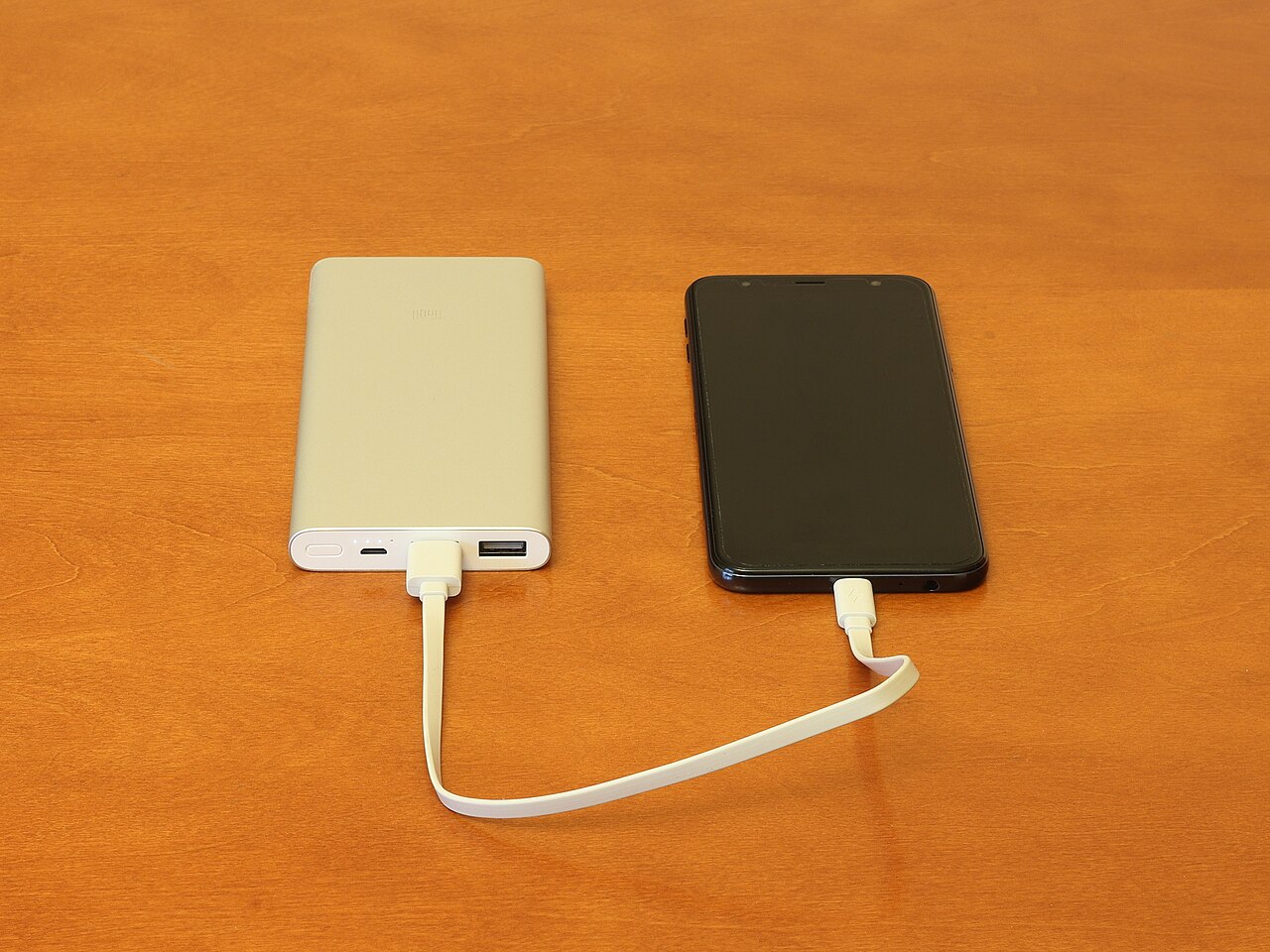
A power bank marked “10000 mAh”. A phone whose specification says “5000 mAh”. The division promises two full charges, and in practice the phone does not fill up even twice. A laptop lies next to them, and its data sheet gives watt-hours instead of milliampere-hours — 99 Wh. Two batteries and two different units, with no visible connection between them.
The familiar guess is that milliampere-hours are “how much energy is inside”, just written in smaller figures. Then 10000 is twice 5000 and the arithmetic ought to come out. It does not. The false step is the very first assumption: a milliampere-hour does not measure energy at all.
Dividing one number by the other quietly assumes two things — that both were measured the same way, and that nothing stands between the power bank and the phone. Both assumptions are wrong, and each in its own way.
Two different rows of one table
The NIST reference on standard units, Special Publication 811, converts both units by one and the same factor — 3.6 × 10³. That coincidence is what makes them look interchangeable. What they convert into is not the same at all: an ampere-hour yields coulombs, a watt-hour yields joules.
The same publication carries a table of derived SI units, and there the two stand in different rows. The coulomb is described as “electric charge, amount of electricity”. The joule as “energy, work, amount of heat”. So an ampere-hour measures charge and a watt-hour measures energy, and these are not two ways of saying the same thing.
That table is not about batteries at all — it is about units, and the word “power bank” does not appear in it. Which is exactly why it closes the question: if two symbols stand in different rows, no wording on a box will fuse them into one.
Charge is how many electrons went past. Energy is how much work they did on the way. The same number of electrons does a different amount of work depending on the voltage it moves under.
The formula where the amperes cancel
What is missing is voltage, and it enters the definition in so many words. The UN Manual of Tests and Criteria — the document by which batteries are cleared for transport — states in sub-section 38.3.2: “Nominal energy or Watt-hour rating, expressed in watt-hours, means the energy value of a cell or battery determined under specified conditions and declared by the manufacturer. The nominal energy is calculated by multiplying nominal voltage by rated capacity expressed in ampere-hours.”
Note how carefully that is worded: determined under specified conditions, declared by the manufacturer. A watt-hour on a label is therefore not something the buyer measured but a stated figure the maker has put its name to.
That this is not a matter of agreement shows in the same NIST table, where the volt is given as “volt — V — W/A”. Substitute and cancel:
A·h × W/A = W·h
The amperes go. Watt-hours remain, and the formula turns out to be arithmetic of units rather than a convention — voltage is precisely what turns charge that has passed into work that has been done.
Take 10 000 mAh — the same thing as 10 Ah — and apply three different nominal voltages to it. The left column never moves: the label reads identically in every row.
| Capacity | Nominal voltage | Energy |
|---|---|---|
| 10 Ah | 3.6 V | 36 Wh |
| 10 Ah | 7.2 V | 72 Wh |
| 10 Ah | 18 V | 180 Wh |
The right column spans a factor of five. Which is why milliampere-hours do not compare across devices of different voltage, and nearly everything has a different voltage.
Whence the laptop and its 99 Wh. Makers of laptops and of power banks meant for air travel print watt-hours for a reason: in watt-hours the quantity is comparable, in milliampere-hours it is not. Transport rules are written in watt-hours, which is why the UN manual had to give the quantity a definition of its own in the first place.
Where the figure is already printed
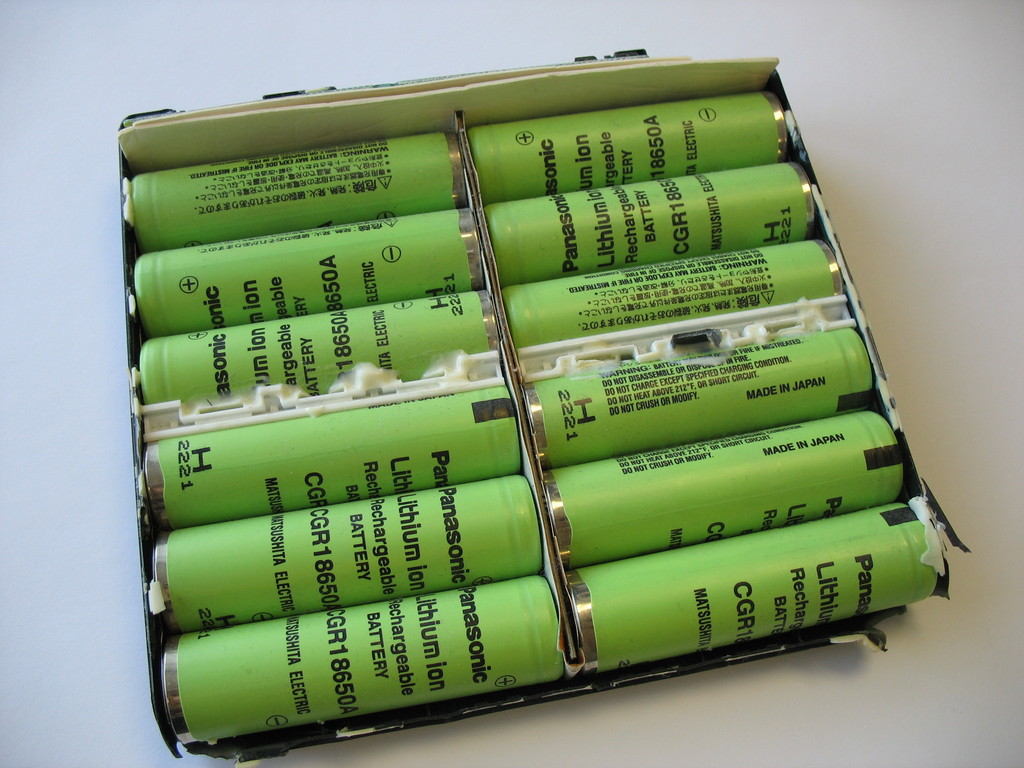
Turn the power bank over. In small type beside the large “10000 mAh” there are almost always watt-hours as well — the figure that means something, and the one by which models are actually compared.
Compare two power-tool batteries. “5 Ah” on an 18 V platform is 90 Wh; “5 Ah” on a 12 V platform is 60 Wh. The label reads the same, the first holds half as much again, and no shop explains this.
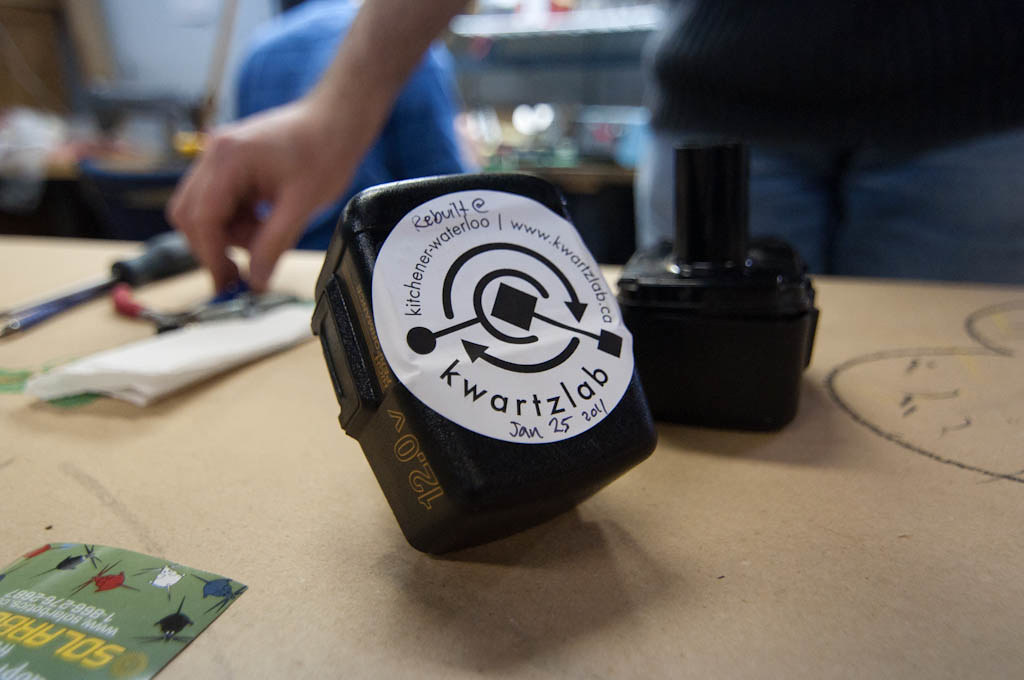
It shows most sharply when the classes of device swap places. A tool battery marked “5000 mAh” is half the size of a power bank marked “10000 mAh” — by the marking. By energy it holds 90 Wh on an 18 V platform, while those same 10 000 mAh give 36 Wh at 3.6 volts and 72 Wh at 7.2. Smaller number, more energy.
Look into a laptop's data sheet. Nothing needs working out there: the watt-hours are stated directly, because that is the custom for this class of device.
None of these checks calls for an instrument — everything needed is printed already. Two power banks are compared by watt-hours, two tool batteries by watt-hours as well, and a power bank and a laptop finally land on one scale, because a watt-hour means the same thing in both.
Between the cell and the socket
Watt-hours make the comparison honest at the level of the cell, but they promise nothing about how much of it reaches the phone. A voltage converter sits between the power bank's battery and its socket, and part of the energy goes on the conversion itself. How much depends on the particular circuit; the sources used here set no figure for it, so I quote none.
Another limit sits inside the definition itself. Defining capacity, the UN manual enters a caveat of its own: “Rated capacity means the capacity, in ampere-hours or milliampere-hours, of a cell or battery as measured by subjecting it to a load, temperature and voltage cut-off point specified by the manufacturer.” Whoever writes the number picks the conditions it was measured under. So two power banks with identical 10 000 mAh and identical voltage could have measured that capacity differently, and the figures on the boxes alone will not show the difference.
There the UN manual stops as well. It was written for the carriage of dangerous goods: it says how to work out watt-hours and what to declare, and it says nothing whatever about how many times a power bank will charge a phone. Watt-hours give an honest comparison between two boxes — and hand a promise to neither.
The sources this article was written from
- NIST Special Publication 811, Appendix B — the unit conversion tables; verbatim: «ampere hour (A·h) → coulomb (C), 3.6 E+03» and «watt hour (W·h) → joule (J), 3.6 E+03»
NIST SP 811 (2008) — https://nvlpubs.nist.gov/nistpubs/Legacy/SP/nistspecialpublication811e2008.pdf - NIST Special Publication 811, the table of derived SI units; verbatim: «electric charge, amount of electricity — coulomb — C», «energy, work, amount of heat — joule — J», «volt — V — W/A»
NIST SP 811 (2008) — https://nvlpubs.nist.gov/nistpubs/Legacy/SP/nistspecialpublication811e2008.pdf - UN Manual of Tests and Criteria, sub-section 38.3.2 — the definition of Nominal energy; verbatim: «Nominal energy or Watt-hour rating, expressed in watt-hours, means the energy value of a cell or battery determined under specified conditions and declared by the manufacturer. The nominal energy is calculated by multiplying nominal voltage by rated capacity expressed in ampere-hours.»
UN Manual of Tests and Criteria, 6th revised edition, sub-section 38.3 — https://unece.org/fileadmin/DAM/trans/danger/publi/manual/Manual%20Rev5%20Section%2038-3.pdf - UN Manual of Tests and Criteria, sub-section 38.3.2 — the definition of Rated capacity; verbatim: «Rated capacity means the capacity, in ampere-hours or milliampere-hours, of a cell or battery as measured by subjecting it to a load, temperature and voltage cut-off point specified by the manufacturer.»
UN Manual of Tests and Criteria, 6th revised edition, sub-section 38.3 — https://unece.org/fileadmin/DAM/trans/danger/publi/manual/Manual%20Rev5%20Section%2038-3.pdf