Why does a 3D printer nozzle stop holding its size?
Printing plastic can be a fifth to a quarter glass or carbon by weight, and on their way out those hard particles sand the hole in the nozzle: it grows and stops being round. The program that prepares the print, meanwhile, computes every extrusion width from a number somebody typed in by hand.
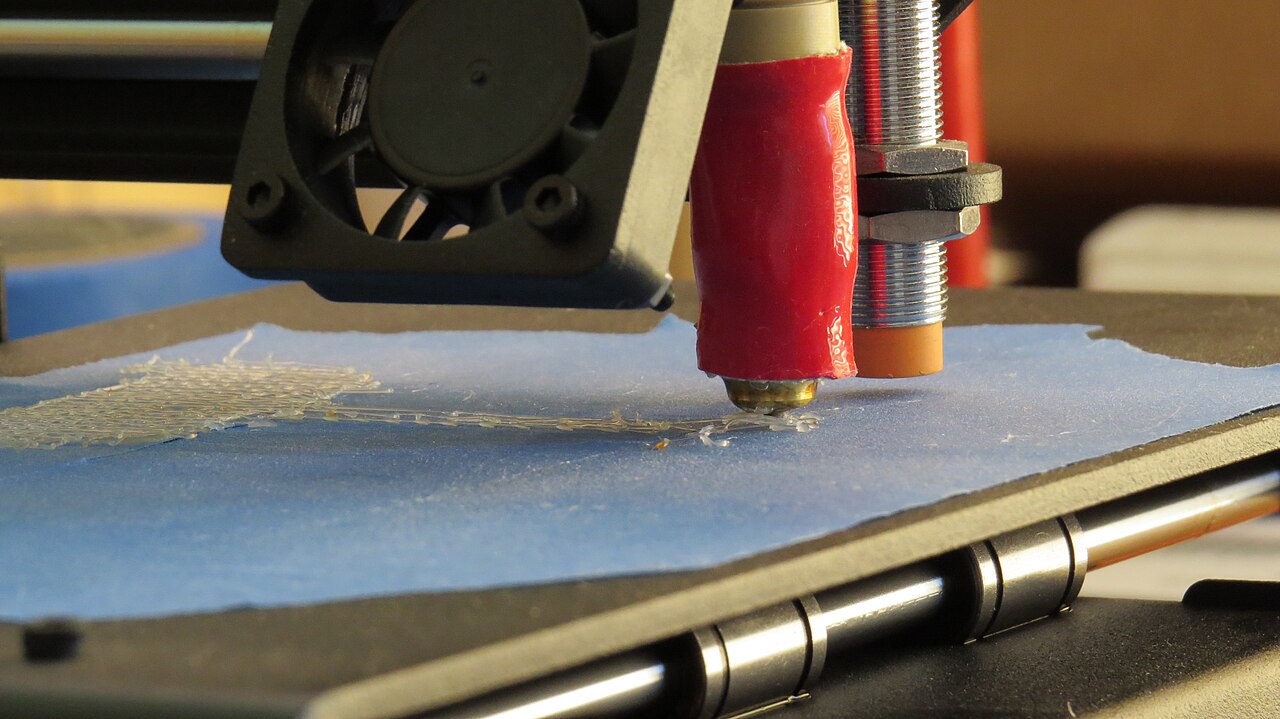
A 3D printer was dialled in months ago and then left alone. Two spools of a stiff black plastic have gone through it since — the kind sold with «carbon reinforced» on the box. Nobody touched the profile, the brand on the box has not changed, and yet the first layer now spreads wider than it used to. Embossed lettering on top surfaces comes out mushy. Slice the same file again and the lines are fat again.
The obvious reading is a partial clog, or a damp spool: run a cold pull, dry the plastic, carry on. Both are worth doing, and neither matches the direction of the defect. A clog and wet filament each make a machine deliver less material than the program asked for, and this one is delivering more. Meanwhile the word abrasive, printed on the box, tends to get read as a note about the finish of the print, or as an argument for an expensive nozzle.
The filler is a fifth of the spool, by weight
The digits after CF or GF in a material's name are not branding. Polymaker explains them in a single line: the number is the filler content by weight, so PPS-CF10 is a tenth carbon. By the same rule PA6-GF25 turns out to be exactly what its own page says — a nylon carrying a quarter glass fibre by weight. colorFabb describes its XT-CF20 no differently: no less than twenty per cent specially sourced carbon fibre.
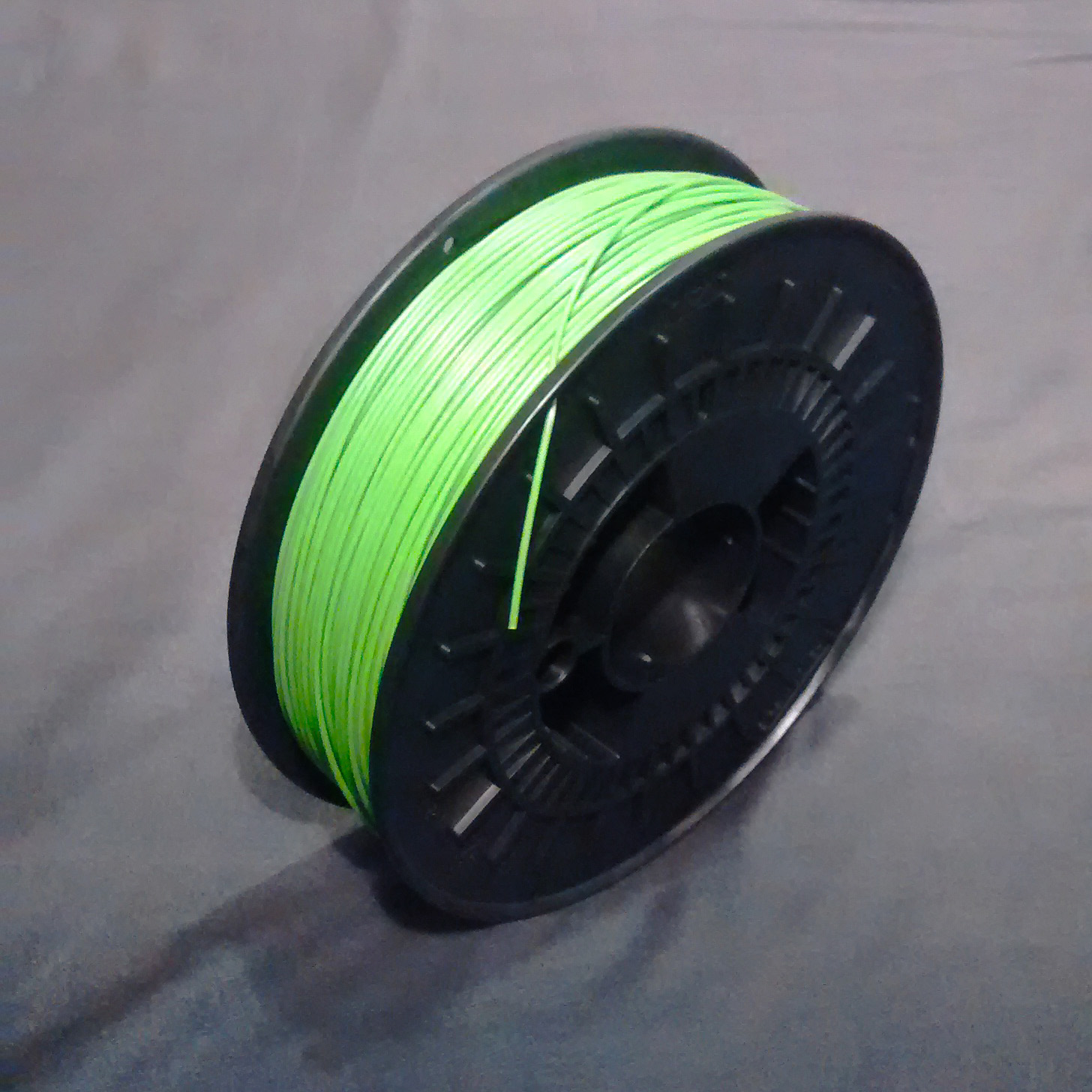
A quarter by weight means that of every four grams pushed through the tip, one is glass. Not a coating on the strand, not an additive measured in parts per million. A quarter of the mass, arriving continuously at a hole four tenths of a millimetre across, under the pressure it takes to make molten nylon come out the other side. Bambu Lab drops the euphemism and writes in its guide that such particles behave like sandpaper: over time they erode the inner surfaces of the nozzle and the extruder gears.
Brass is in the hotend for heat, not for hardness
The Prusa knowledge base opens with a statement of fact: its FFF printers come with a brass nozzle. Then it names the reason and the cost together — brass conducts heat excellently and is tough enough for most common filaments, but on abrasives it wears too quickly, which is why abrasion-resistant nozzles are sold at all. For filled materials Bambu Lab words the same thing as a prohibition: do not fit stainless steel and do not fit brass, their hardness is insufficient.
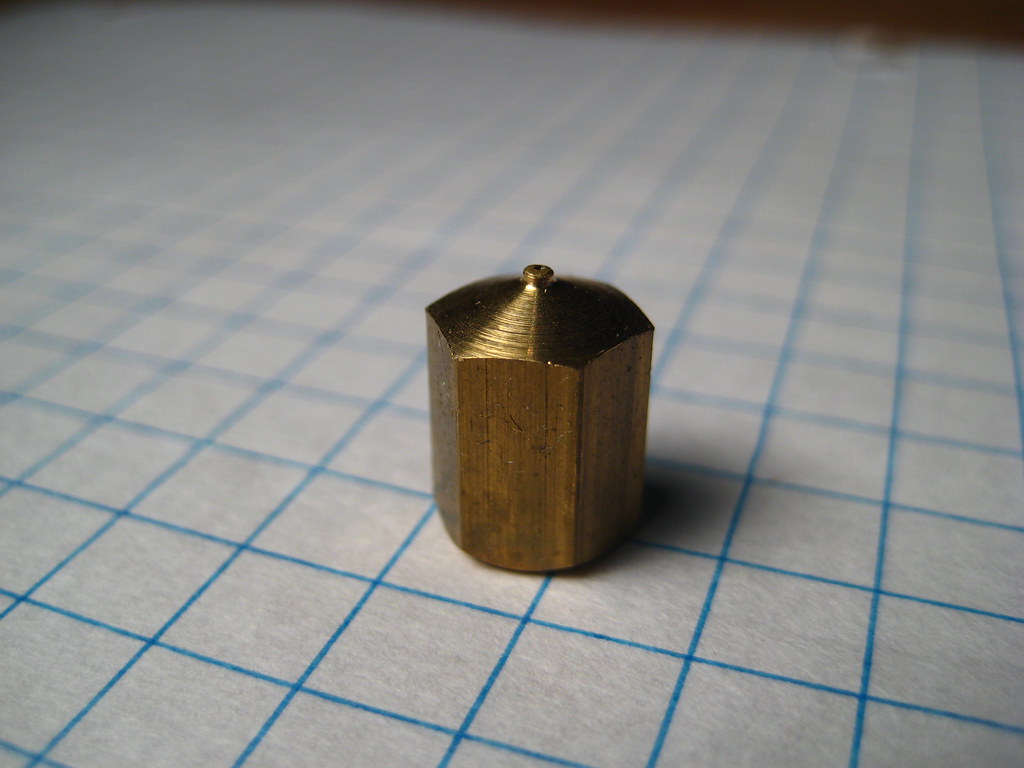
Stainless steel sits on that list beside brass, under the same one-word reason: hardness.
That hardness and heat conduction pull against each other is easiest to see in a product built to have both. The Olsson Ruby, as Prusa describes it, is mostly brass — which is how it keeps the heat conductivity and throughput of a stock nozzle — with a very hard gemstone at its tip. Brass everywhere it does its job, gemstone only where it does not.
Switching to hardened steel is not free either. Prusa puts a figure on it: to print successfully with one, the hotend temperature goes up by about five degrees. It adds that some standard materials, ABS among them, can no longer be printed as fast as with a regular nozzle.
The hole grows, and the program never finds out
Bambu Lab photographs the outcome and dates it: the stainless steel nozzle on the right had printed PETG-CF for ten hours. What the photograph shows is written directly underneath — seen from the front, the worn nozzle has a visibly larger orifice, and the abrasion of the filament is what produced it.
Ten hours. And that nozzle was one of the two the same manufacturer rules out for filled plastics, while higher up the page the short end of the range is given too: the most abrasive filaments can ruin a nozzle in a single print.
The load-bearing word in that description is not larger. The failure is listed differently by Bambu Lab: worn nozzles develop irregular or enlarged orifices, and filament flow goes uneven because of it. Two adjectives, two different ways to break a print. An orifice that had grown evenly to some new round diameter would be a recoverable problem: type the new number into the program, or trim the flow multiplier, and the walls come back. Irregular is not recoverable by any number. Extrusion width then depends on which direction the head happens to be travelling, and no single value in a profile can describe a shape that is no longer a circle.
That mismatch is the whole defect. A nozzle diameter in the program is an input the operator types, not a measurement the machine takes, and every extrusion width and every first-layer squish is computed downstream of it. The plastic keeps obeying physics. The arithmetic keeps obeying a number that quietly stopped being true somewhere in the second spool.
Why the fix arrives with a bigger hole
Hardened steel is not offered in the finest size at all: it comes in 0.4, 0.6 and 0.8 mm, and 0.2 mm is not made. For filled materials Bambu Lab rules that size out on separate grounds anyway — the clogging risk is extremely high — and then orders the remaining choices, 0.6 mm first and 0.4 mm second. The trade is stated outright: a larger diameter means less print detail and less clogging risk.
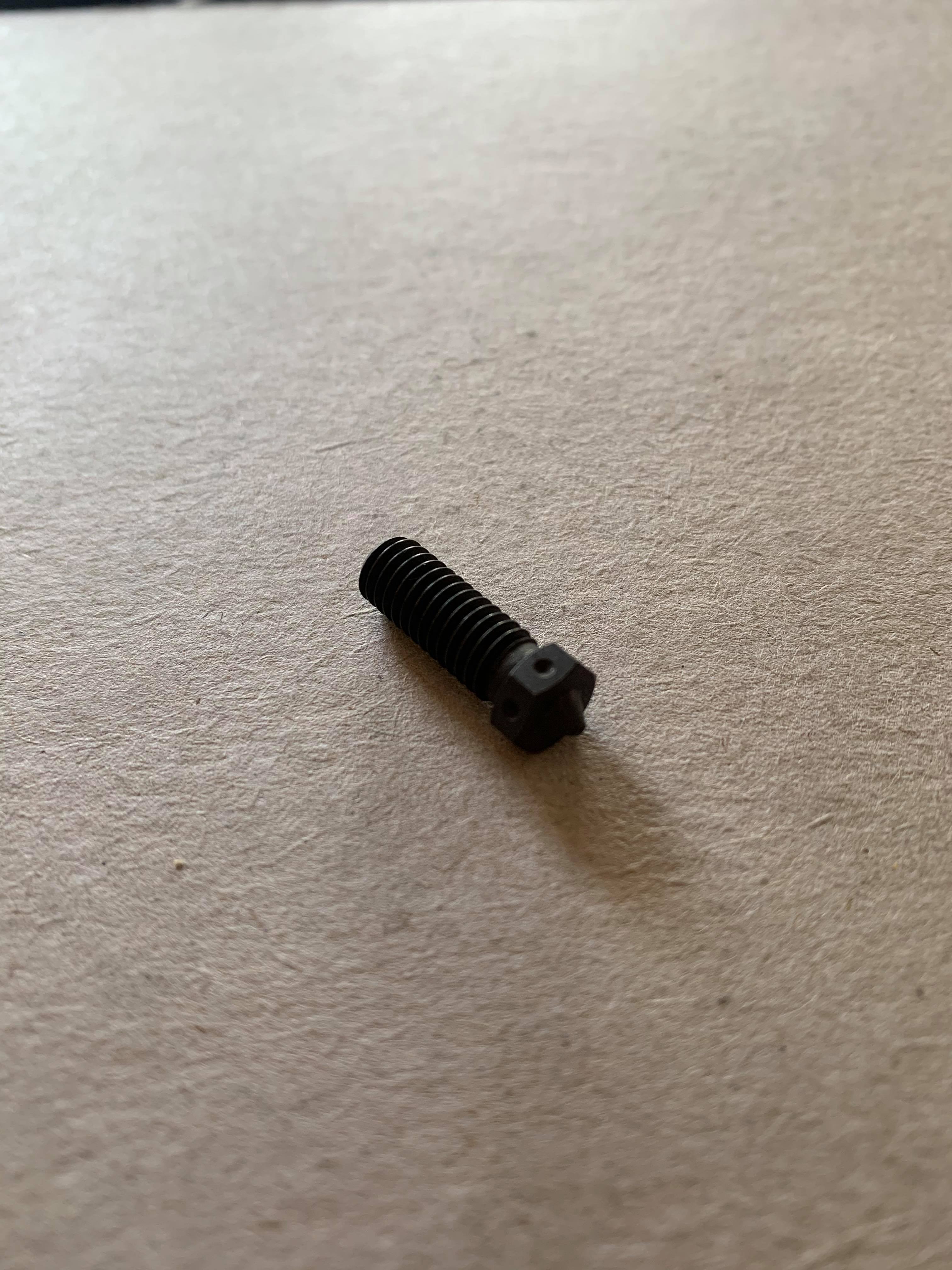
Detail is therefore paid for twice by anyone moving to filled plastics: once at the nozzle diameter, once at those five degrees and the slower ABS.
Nor is the nozzle the only part being sanded. Bambu Lab's warning about its filament changer notes that abrasive materials grind down the internal PTFE feed channels over time, which is exactly why those channels are listed as replaceable.
Reading the spool before it reaches the hotend
Start with the digits in the material's name, which on at least one manufacturer's range are a specification rather than branding. PA6-GF25 is a quarter glass by weight, PPS-CF10 a tenth carbon, and Polymaker names the single exception in its family, PETG-ESD, which is not abrasive.
Then the vendor's page, where the requirement tends to live. Prusa publishes Abrasivity as a property line, and for PC Blend Carbon Fiber it reads High, with a hardened steel nozzle listed among the drawbacks. The technical datasheet for that same filament runs to three pages of temperatures and test standards without mentioning nozzles once. Where no such page exists, the knowledge base falls back on the unglamorous answer: ask your vendor.
The nozzle itself takes a minute, using Bambu Lab's own method of looking at it from the front — with an unused second nozzle of the same nominal size held beside it. You are looking for a difference, not an absolute.
A requirement with no number
None of these manufacturers publishes a wear rate. A datasheet states a requirement — hardened nozzle — and never a mass or a number of hours after which brass stops holding its size. The one time figure anywhere in the set is Bambu Lab's ten hours, which sits under a photograph rather than in a specification and describes a single pairing, PETG-CF against stainless steel. Hardened steel is not the top of the ladder either. Prusa writes that its coated Nozzle X copes with the usual glass and carbon reinforcement — Kevlar as well — but not with harsher fillers: boron carbide, boron itself, boron nitride, tungsten, tungsten carbide.
The sources this article was written from
- Prusa Knowledge Base, E3D V6 Nozzles — «The Prusa FFF printers are equipped with a brass nozzle»; «Brass has excellent heat conductivity and is tough enough to print most common filaments. However, when using abrasive filaments, the brass nozzle tends to wear too quickly, so abrasion-resistant nozzles are available»; «increase the hotend temperature by about 5°C to print successfully with the hardened steel nozzle»; «some standard materials, like ABS, cannot be printed as fast as a regular nozzle»; on the Olsson Ruby — «Since it is mostly made of brass, it retains the excellent heat conductivity and throughput of the stock brass nozzle, but with a very hard gemstone as its tip»; «hardened steel nozzles are available in various diameters (e.g., 0.4mm, 0.6mm, 0.8mm) but the 0.2mm nozzle is not available»; on Nozzle X — «glass, Kevlar, or carbon reinforcement, but does not support more abrasive fillers, like Boron Carbide, Boron, Boron Nitride, Tungsten, or Tungsten carbide»; «Always ask your filament vendor if you are not sure about filament requirements»
Prusa Research — https://help.prusa3d.com/article/e3d-v6-nozzles_920168 - Bambu Lab Wiki, P1S Abrasive Filament Extruder Upgrade Guide — «contain particles … that act like sandpaper, eroding the inner surfaces of the nozzle and extruder gears over time»; the photograph caption «The right Stainless Steel Nozzle was used to print PETG-CF for 10 hours» and «Looking at the nozzles from the front, you can see how the worn-out nozzle has developed a larger orifice due to the abrasion of the filament used»; «Worn nozzles develop irregular or enlarged orifices, causing uneven filament flow …»; «For the most abrasive filaments, the nozzle can be damaged after a single print»; on the filament changer — «can eventually grind down the internal PTFE feed channels»
Bambu Lab — https://wiki.bambulab.com/en/p1/manual/p1s-extruder-upgrade - Bambu Lab Wiki, Filament guide — «Do not use a stainless steel or brass nozzle. Their hardness is insufficient, so they wear out quickly …»; «Do not use a 0.2 mm nozzle. The clogging risk is extremely high»; «As the diameter increases (0.4 mm → 0.6 mm → 0.8 mm), print detail decreases, but the clogging risk also decreases accordingly»
Bambu Lab — https://wiki.bambulab.com/en/general/filament-guide-material-table - colorFabb XT-CF20 product page — «Loaded with no less than 20% specially sourced carbon fibers», plus the statement on brass nozzle wear
colorFabb — https://colorfabb.com/xt-cf20 - Polymaker Wiki, Fiberon — «Please note that the number after CF or GF in Fiberon™ material names indicates the content by weight. For example, PPS-CF10 contains 10% carbon fiber by weight»; on PETG-ESD — «which is not abrasive»
Polymaker — https://wiki.polymaker.com/polymaker-products/polymaker-filaments/fiberon-tm - Polymaker Wiki, Fiberon PA6-GF25 — «a glass fiber reinforced PA6 (Nylon 6) filament containing 25% glass fiber by weight», hardened nozzle requirement
Polymaker — https://wiki.polymaker.com/polymaker-products/polymaker-filaments/fiberon-tm/fiberon-tm-pa6-gf25 - Prusament PC Blend Carbon Fiber — the property line Abrasivity: High and the drawback «Hardened steel nozzle needed (abrasive material)»; technical datasheet v2.0-OY never mentions nozzles
Prusa Polymers — https://prusament.com/wp-content/uploads/2023/04/TDS_Prusament-PCCF_2023_EN.pdf