What do 91V and 2519 on a tyre sidewall mean?
The size on a sidewall really is the size. The 91 and the V are not properties of the tyre at all but row numbers in tables inside UNECE Regulation No 30, and the alphabet there does not follow speed. The four digits in the raised oval are the only marking that describes the tyre in your hands rather than the design it was moulded from.
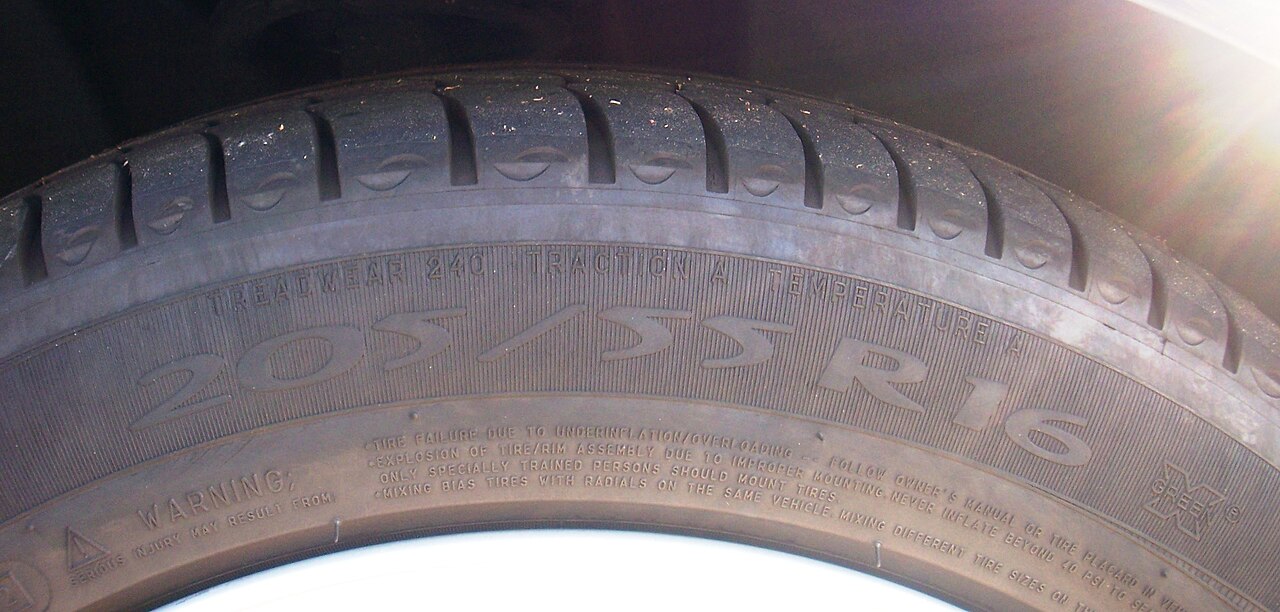
Two tyres on the rack in a fitting shop carry the same size, 205/55 R 16. One is stamped 91V after it, the other 94H, and the 94H costs less. Somewhere else on the sidewall — the outward-facing wall of the tyre — a small raised oval holds four digits: 2519 on one, 0126 on the other. The fitter confirms both will go on the car.
The natural reading is that these are grades. A letter that runs later in the alphabet ought to mean more of something, a bigger number ought to mean better, and the four digits look like a factory batch code that concerns nobody who buys the tyre. On that reading V outranks H, because V comes after it. The inference is wrong. The alphabet will never warn you about it.
The sidewall is an index, not a description
New car tyres are approved across the 1958 Agreement countries under UNECE Regulation No 30, which the European Union republishes in the Official Journal. Paragraph 3.1 lists what has to be moulded into the rubber: the trade name, the size designation, an indication of structure, the speed category symbol, the load-capacity index, the date of manufacture, and a handful of words such as TUBELESS and REINFORCED.
Notice what two of those fields lack: a unit. Paragraph 2.28 says the load-capacity index is a number associated with the reference mass a tyre can carry when it is used as the manufacturer specifies. Associated with a mass — not equal to one.
The association lives in Annex IV, a table of 121 rows running from index 0 to index 120. Two characters have to cover everything from a light trailer to a heavy van, so the scale is not linear. Index 0 stands for 45 kg and index 120 for 1400 kg, and the step between neighbouring rows grows as you go down: about a kilogram near the top of the table, fifteen to twenty-five in the range that fits a family car.
So the 91 and the 94 differ by more than three. Annex IV puts 615 kg beside index 91 and 670 kg beside index 94 — 55 kg per tyre, 220 kg across a set of four. The regulation works its own example in Annex III, describing a tyre with a load capacity of 580 kg and stating that index 89 corresponds to it.
The speed symbol does not read alphabetically
The second key behaves the same way. Paragraph 2.29 defines the speed category as the highest speed a tyre can sustain, expresses it as a single symbol, and then prints the table. Here are six of its rows, in the order the document itself gives them:
| Symbol | Speed |
|---|---|
| T | 190 km/h |
| U | 200 km/h |
| H | 210 km/h |
| V | 240 km/h |
| W | 270 km/h |
| Y | 300 km/h |
H sits between U and V rather than after them; the full run reads L, M, N, P, Q, R, S, T, U, H, V, W, Y. Ranking T against H by alphabet gives the right answer by luck. The same method applied to H against U gives the wrong one.
Speed takes part of the load away
For speeds up to 210 km/h the plain case is set by paragraph 2.31.1: the maximum load rating must not exceed the value tied to the tyre's load-capacity index. Above that ceiling the regulation derates the load, and it does so with a table of percentages. For a tyre carrying the symbol V, paragraph 2.31.2 allows 98,5 per cent of the tabulated mass at 215 km/h and 91 per cent at 240 km/h — the very speed the letter V stands for.
Put the two tables together and the 615 kg turns into something smaller. 615 × 0,91 = 559,65 kg per tyre at 240 km/h. Annex IV lists 560 kg against index 88. At the speed printed on its own sidewall, then, a 91V tyre is rated to carry marginally less than a plain 88 does at ordinary speeds — and the sidewall gives no hint of it.
What the letter was actually earned by
Annex VII describes the load/speed test behind the letter, and its numbers are smaller than the letter suggests. The tyre is inflated to a pressure fixed by its speed category, pressed against a smooth drum of 1,70 m or 2 m diameter, and loaded to 80 per cent of its maximum load rating. Ten minutes are allowed to reach the initial test speed, which on the 1,70 m drum is the marked speed less 40 km/h. From there the speed rises in steps of 10 km/h: ten minutes at each step and twenty at the last, and the last step is the marked speed less 10 km/h.
Work that through for a tyre marked T. The steps are 150, 160, 170 and 180 km/h, so the running time is 10 + 10 + 10 + 20 = 50 minutes, an hour with the ramp-up included, and 190 km/h is never reached at all on the smaller drum. Paragraph 6.2.2 makes passing one single thing: after the test the tyre must show no tread separation, no ply separation, no cord separation, no chunking, no broken cords.
The letter certifies that one new tyre survived that hour without coming apart. It is a threshold, not an endurance rating. About the same tyre after four summers on a roof rack the procedure says nothing.
The four digits are the only field about this particular tyre
Paragraph 3.1.9 is short and carries the sting in its second sentence. The date of manufacture is to be given as a group of four digits, the first two showing the week and the last two the year; and the same paragraph states that this marking is permitted on one sidewall only.
Week first, then year: 2519 is the twenty-fifth week of 2019. Every other marking describes the tyre type, identical across every unit ever moulded from that design. This one describes the object in front of you. A footnote to the same paragraph fixes the older format: before 1 January 2000 the date could be given as three digits, the first two the week and the last one the year. A three-digit code is therefore proof on its own that the tyre predates the century.
The order to read a sidewall in
Find the size first, then read the characters immediately to the right of it. You do not need to recognise a load index by sight, because Annex III fixes the position: the service description, meaning the load index together with the speed symbol, goes immediately after the tyre size designation. Whatever sits in that slot is the pair. Check it against the plate in the driver's door aperture, which states the indices the car was approved with.
Then hunt for the four digits, and hunt on both sides of the wheel. Paragraph 3.1.9 permits the date on one sidewall only, so a wheel can be perfectly legal and still show you nothing: the dated face is turned in towards the brake. A tyre offered as new this month with 2519 on it spent more than seven years in a warehouse before touching tarmac, and the price will not mention it.

The rule is silent on age
Regulation No 30 requires the date to be moulded on, and then says nothing more about it. No paragraph sets a shelf life, an expiry date, or a maximum age at the point of sale. The EU tyre label under Regulation (EU) 2020/740 does not close the gap either: its Annex III repeats the size, the load-capacity index and the speed symbol from Regulation No 30, and the date it does mention is the date on which production of the tyre type started. The design, not the tyre.
The sources this article was written from
- UNECE Regulation No 30, Rev. 3 — the two unitless fields, paras 2.28 and 2.29 plus Annex IV; verbatim: «'Load-capacity index' means a number associated to the reference mass a tyre can carry when operated in conformity with requirements governing utilization specified by the manufacturer» and «the maximum speed which the tyre can sustain, expressed by speed category symbol»
Regulation No 30 of the Economic Commission for Europe (UN/ECE), OJ L 201, 30.7.2008, p. 70 — https://eur-lex.europa.eu/legal-content/EN/TXT/HTML/?uri=CELEX:42008X0730(01) - UNECE Regulation No 30, Rev. 3 — load tied to speed, paras 2.31.1 and 2.31.2, the Annex VII load/speed test and the pass criterion in para 6.2.2; verbatim: «shall not exceed the value associated with the load capacity index of the tyre» and «A tyre which after undergoing the load/speed test does not exhibit any tread separation, ply separation, cord separation, chunking or broken cords shall be deemed to have passed the test»
Regulation No 30 (UN/ECE), OJ L 201, 30.7.2008, p. 70 — https://eur-lex.europa.eu/legal-content/EN/TXT/HTML/?uri=CELEX:42008X0730(01) - UNECE Regulation No 30, Rev. 3 — the mandatory markings in para 3.1, the date of manufacture in para 3.1.9 with its footnote on the three-digit format, and the position of the service description in Annex III; verbatim: «The date of manufacture in the form of a group of four digits, the first two showing the week and the last two the year of manufacture. However, this marking which may be placed on one sidewall only, shall not be mandatory, on any tyre submitted for approval, until two years after the date of entry into force of this Regulation», «the service description comprising the load index and the speed symbol shall be placed immediately after the tyre size designation» and «having a load capacity of 580 kg, corresponding to load index 89 in Annex IV to this Regulation»
Regulation No 30 (UN/ECE), OJ L 201, 30.7.2008, p. 70 — https://eur-lex.europa.eu/legal-content/EN/TXT/HTML/?uri=CELEX:42008X0730(01) - Regulation (EU) 2020/740, Article 4 and Annex III — the tyre label and product information sheet; the date it does mention is «the date of start of production of the tyre type»
Regulation (EU) 2020/740 — https://eur-lex.europa.eu/legal-content/EN/TXT/HTML/?uri=CELEX:32020R0740