Why does one charger now fit every device?
The directive fixed construction, not packaging: a USB-C socket on the device itself, USB Power Delivery inside anything that charges above 15 watts, and a ban on narrowing it for the sake of a proprietary protocol. The empty box comes from a separate article, far weaker than its reputation.
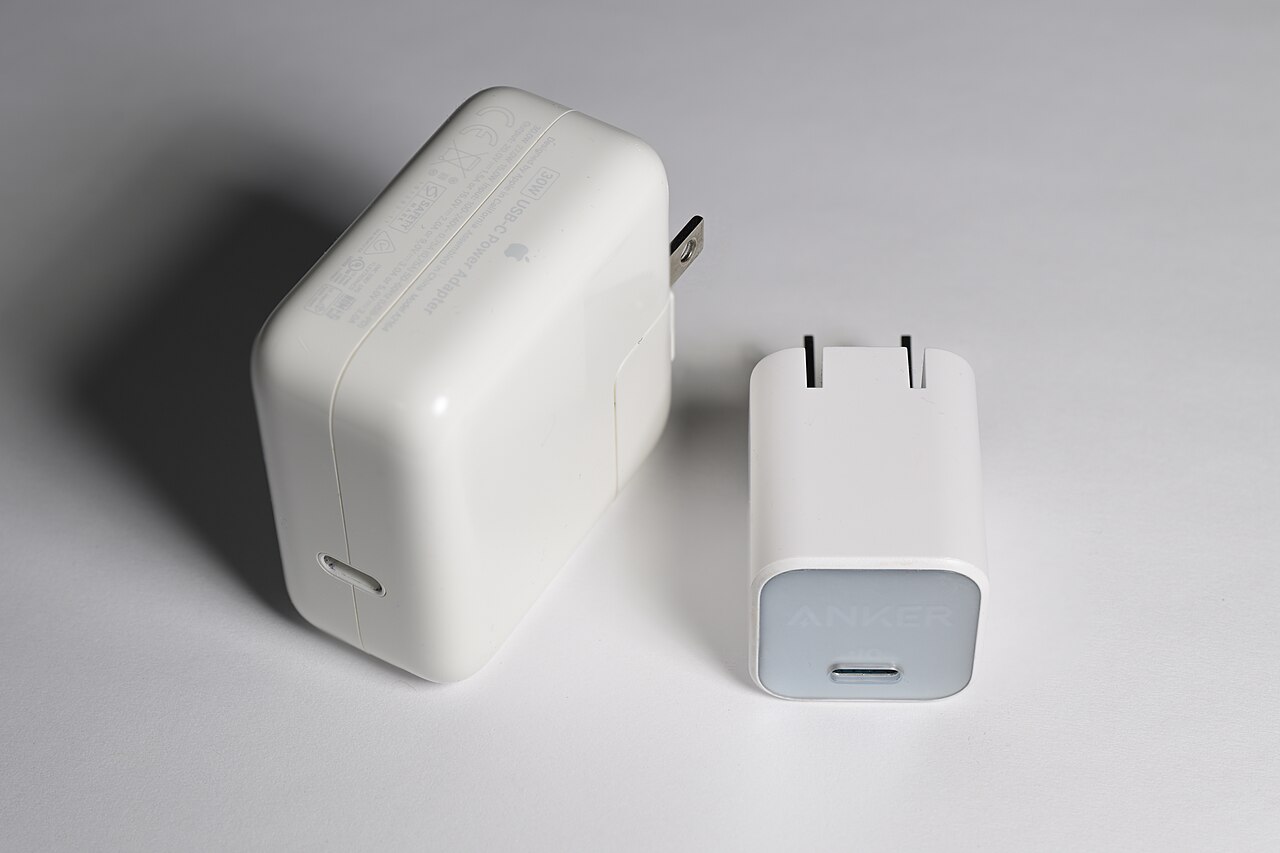
Inside the box of new earbuds is a cable and no charger at all. The white plug that goes into the wall is simply absent: instead, on the back near the barcode, a small drawing of a mains plug has a line struck through it, and beside the drawing sits a printed rectangle carrying two numbers in watts and three letters, USB PD. The phone bought two years earlier takes the same cable. So does the e-reader.
The usual reading is that manufacturers found a way to sell the plug separately and dressed the saving up as an environmental gesture, while Brussels banned one connector in favour of another. Both accounts describe the box. Neither explains why fast charging no longer disappears when somebody else's plug goes into the device, nor why anybody prints wattages on packaging.
Directive (EU) 2022/2380 does not stand on its own. It amends the Radio Equipment Directive 2014/53/EU and inserts a new Annex Ia into it, and the operative sentence it adds as Article 3(4) is about hardware rather than commerce:
Radio equipment falling within the categories or classes specified in Part I of Annex Ia shall be so constructed that it complies with the specifications relating to charging capabilities set out in that Annex …
Shall be so constructed. The rest follows from that verb.
Thirteen categories, one socket
The list of what is covered opens Part I, numbered 1.1 through 1.13: handheld mobile phones; tablets; digital cameras; headphones; headsets; handheld videogame consoles; portable speakers; e-readers; keyboards; mice; portable navigation systems; earbuds; laptops. The recitals narrow it further than the list shows. Only equipment with a removable or embedded rechargeable battery is concerned, and earbuds are taken together with their charging case, which the directive declines to count as part of the charging device.
Point 2 then states the requirement, for any listed device that charges over a wire:
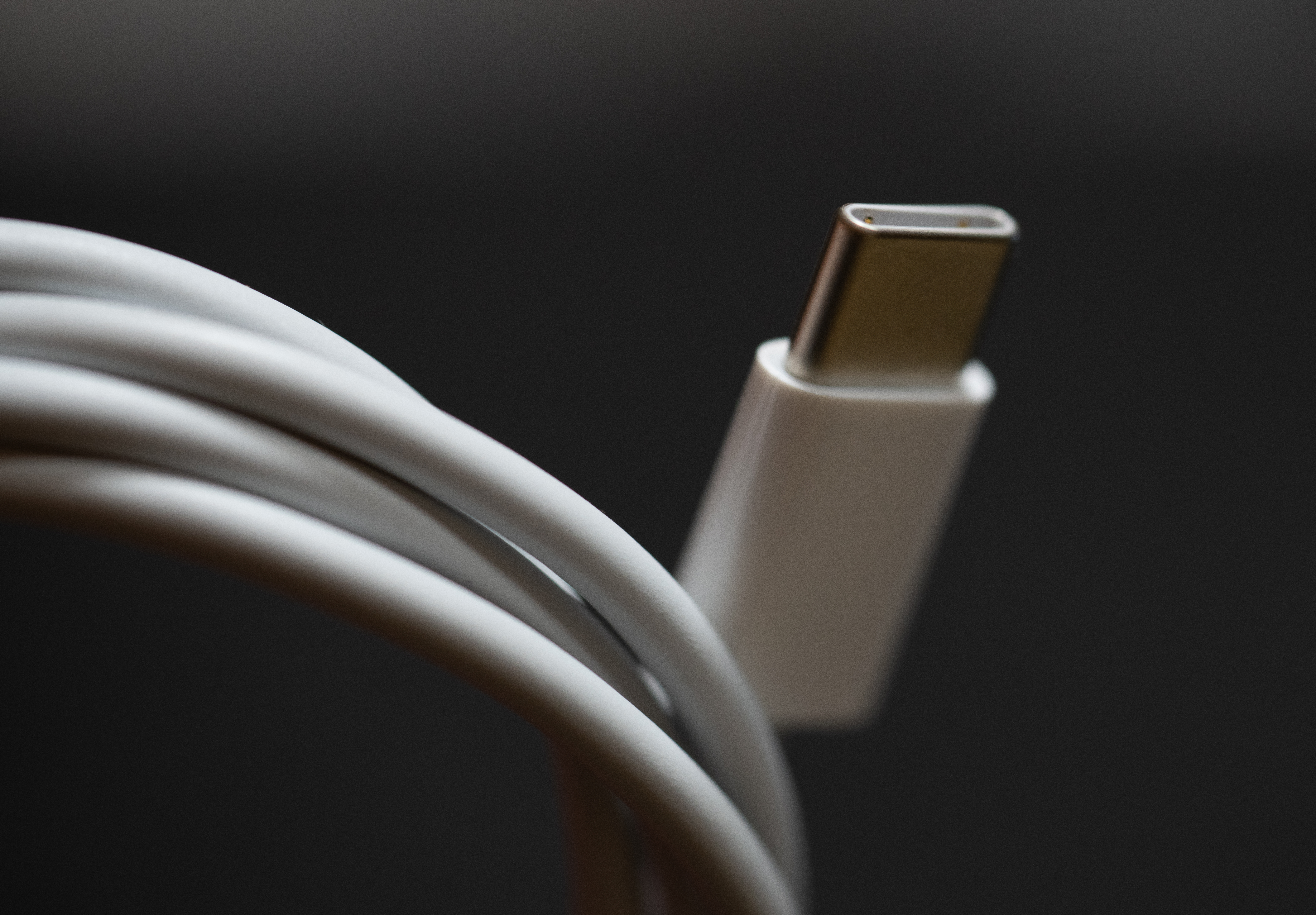
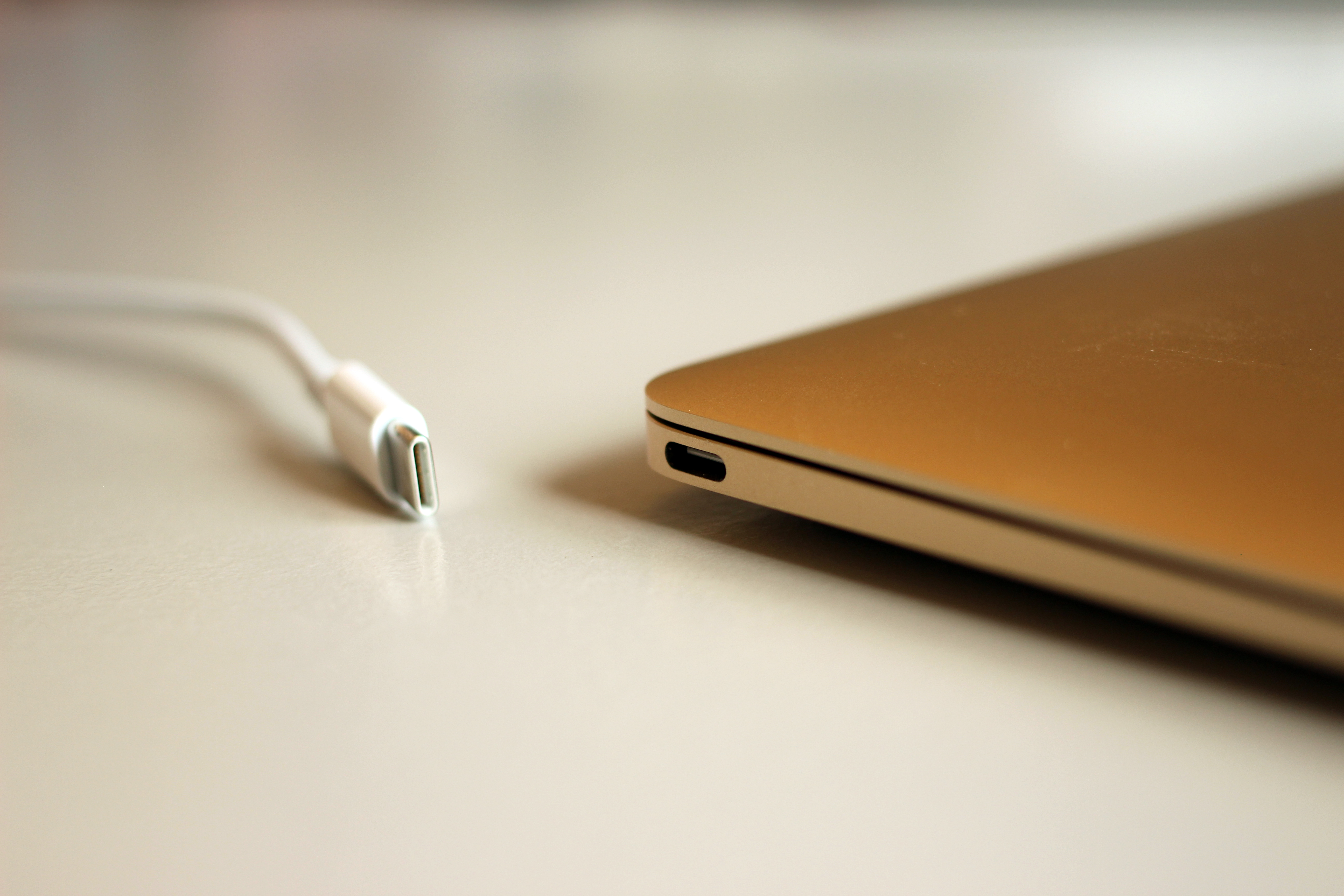
be equipped with the USB Type-C receptacle, as described in the standard EN IEC 62680-1-3:2021 … and that receptacle shall remain accessible and operational at all times
Most of the work in that sentence is done by its tail. A socket behind a glued panel satisfies the first half and fails the second; a socket wired for data and left dead for power fails it the same way.
The line runs at fifteen watts
Nothing in the annex tells anyone to charge fast. It says that a device which charges fast has to keep doing so when a charger it was not sold with is plugged in — which means the text needs a definition of "fast". Point 3 supplies one by naming the ordinary ceiling of USB-C supply: its obligations attach to equipment rechargeable "at voltages higher than 5 Volts, currents higher than 3 Amperes or powers higher than 15 Watts".
5 V × 3 A = 15 W
Three figures, one threshold, stated three ways so that nothing slips between them. A device that stays underneath is finished with the annex after point 2: the socket and the cable are its whole obligation. Above the line two duties appear together: incorporate USB Power Delivery as described in EN IEC 62680-1-2:2021, and obey point 3.2.
What one sentence about a stranger's charger changes
The sentence that changed silicon rather than cardboard is point 3.2:
ensure that any additional charging protocol allows for the full functionality of the USB Power Delivery referred to in point 3.1, irrespective of the charging device used
Plenty stays legal. A manufacturer keeps its own fast-charging protocol; nothing forbids one. What it can no longer do is let that protocol subtract from USB PD when the charger at the other end of the cable came from somebody else. Top speed behind a handshake only the bundled brick knew, everything else demoted to a trickle — that arrangement is what "irrespective of the charging device used" removes.
Recital 12 explains the choice of this pair over something faster and narrower: USB Type-C with USB Power Delivery "is capable of providing up to 100 Watts of power and therefore leaves ample room for further development of fast charging solutions". The same recital records that the USB Implementers Forum has since published a specification "which enables powers of up to 240 Watts to be supported" — more than double the headroom, noted inside the reasoning of a text adopted in 2022.
The plug leaves the box by offer, not by ban
The most visible part of the directive turned out to be the weakest. Article 3a says this much and no more:
Where an economic operator offers to consumers and other end-users the possibility to acquire the radio equipment referred to in Article 3(4) together with a charging device, the economic operator shall also offer the consumers and other end-users the possibility of acquiring that radio equipment without any charging device.
An obligation to keep a second option on the shelf is not an obligation to empty the box. A seller who puts a charger in with every unit complies, provided a charger-free version can also be bought.
Both versions now sit side by side, so the buyer has to learn which one is in front of them before paying. Article 3a(2) turns that into a printed mark: the pictogram from Part III, on the packaging or stuck to it, and in distance selling placed "close to the price indication". Part III fixes its dimension "a" at 7 mm or greater, so it cannot shrink into the small print.
The second mark is the rectangle with the numbers. Article 10(8) and Part II require the packaging and the instructions to state the power the device needs, in wording the annex writes out for the manufacturer: "the power delivered by the charger must be between min [xx] Watts required by the radio equipment, and max [yy] Watts in order to achieve the maximum charging speed". Anything above the 15-watt line adds "USB PD fast charging" and the name of any other protocol supported. Part IV even defines the abbreviation for the buyer: USB PD "negotiates the fastest delivery of current from the charging device to the radio equipment without shortening the battery lifetime".
The calendar comes in two pieces, and Article 2 sets both. National measures had to be adopted and published by 28 December 2023, then applied from 28 December 2024 for the categories in points 1.1 to 1.12, and from 28 April 2026 for point 1.13. Point 1.13 is the laptops — one category out of thirteen, given sixteen months more than the other twelve.
Minimum and maximum, in watts
Turn the package over and find the rectangle. The lower of its two wattages is what the device needs to charge at all; the upper is what a charger has to supply before the device reaches full speed. A charger in the drawer that delivers less than the upper figure still charges the device — slowly, and lawfully: the label describes the device, not the charger.
Then look for the pictogram: a plug, plain or struck through, at least 7 mm across. On a shop listing it belongs next to the price, not at the bottom of a specifications tab. And if a device advertises fast charging while its label names no protocol at all, one of two things holds — it stays under 15 watts, or the labelling is incomplete.
Standardisation deferred
Wireless charging sits outside all of it. Recital 13 calls specific requirements for it premature; the only concrete step is that the Commission had to ask European standardisation organisations, by 28 December 2024, for standards covering charging interfaces other than wired ones. A request for standards binds no device.
Nor is the empty box compulsory. By 28 December 2026 Article 47 requires a report on what the option to buy without a charger has actually done, accompanied "if appropriate, by a legislative proposal to amend this Directive to introduce mandatory unbundling of the sale of charging devices and cables from the sale of radio equipment" — unbundling named there as something that does not yet exist. The list of categories has its own quiet exits, too: digital cameras designed exclusively for the audiovisual sector or for security and surveillance are not required to integrate the harmonised charging solution, so a proprietary socket on a professional camera is not evidence that anyone is ignoring the rule.
The sources this article was written from
- Article 3(4), inserted into Directive 2014/53/EU — «Radio equipment falling within the categories or classes specified in Part I of Annex Ia shall be so constructed that it complies with the specifications relating to charging capabilities set out in that Annex …»
Directive (EU) 2022/2380 — https://eur-lex.europa.eu/legal-content/EN/TXT/HTML/?uri=CELEX:32022L2380 - Annex Ia, Part I, point 1 — the list of categories 1.1 to 1.13; point 2 — the receptacle: «be equipped with the USB Type-C receptacle, as described in the standard EN IEC 62680-1-3:2021 … and that receptacle shall remain accessible and operational at all times»
Directive (EU) 2022/2380 — https://eur-lex.europa.eu/legal-content/EN/TXT/HTML/?uri=CELEX:32022L2380 - Annex Ia, Part I, point 3 — the threshold «at voltages higher than 5 Volts, currents higher than 3 Amperes or powers higher than 15 Watts»; point 3.1 — USB Power Delivery per EN IEC 62680-1-2:2021; point 3.2 — «ensure that any additional charging protocol allows for the full functionality of the USB Power Delivery referred to in point 3.1, irrespective of the charging device used»
Directive (EU) 2022/2380 — https://eur-lex.europa.eu/legal-content/EN/TXT/HTML/?uri=CELEX:32022L2380 - Recital 12 — USB Type-C with USB Power Delivery «is capable of providing up to 100 Watts of power and therefore leaves ample room for further development of fast charging solutions» and the USB Implementers Forum specification «which enables powers of up to 240 Watts to be supported»; recital 13 — wireless charging and the standardisation request
Directive (EU) 2022/2380 — https://eur-lex.europa.eu/legal-content/EN/TXT/HTML/?uri=CELEX:32022L2380 - Article 3a — «Where an economic operator offers to consumers and other end-users the possibility to acquire the radio equipment referred to in Article 3(4) together with a charging device, the economic operator shall also offer the consumers and other end-users the possibility of acquiring that radio equipment without any charging device»; Article 3a(2) and Part III — the pictogram «close to the price indication», dimension «a» of 7 mm or greater
Directive (EU) 2022/2380 — https://eur-lex.europa.eu/legal-content/EN/TXT/HTML/?uri=CELEX:32022L2380 - Article 10(8) and Annex Ia, Part II — «the power delivered by the charger must be between min [xx] Watts required by the radio equipment, and max [yy] Watts in order to achieve the maximum charging speed»; Part IV — USB PD «negotiates the fastest delivery of current from the charging device to the radio equipment without shortening the battery lifetime»
Directive (EU) 2022/2380 — https://eur-lex.europa.eu/legal-content/EN/TXT/HTML/?uri=CELEX:32022L2380 - Article 2 — dates of application: «from 28 December 2024 for the categories or classes of radio equipment referred to in Part I, points 1.1 to 1.12 of Annex Ia, and from 28 April 2026 for … point 1.13»
Directive (EU) 2022/2380 — https://eur-lex.europa.eu/legal-content/EN/TXT/HTML/?uri=CELEX:32022L2380 - Article 47 — a report by 28 December 2026, accompanied «if appropriate, by a legislative proposal to amend this Directive to introduce mandatory unbundling of the sale of charging devices and cables from the sale of radio equipment»
Directive (EU) 2022/2380 — https://eur-lex.europa.eu/legal-content/EN/TXT/HTML/?uri=CELEX:32022L2380