Will you be able to change your phone's battery yourself?
The European regulation does not describe what a battery has to be. It lists the ways of getting a product open that a manufacturer may not force on you — and that alone strikes the heat-softened adhesive and the screw with its own proprietary head out of the design. A special key supplied free in the box, meanwhile, stays entirely legal.
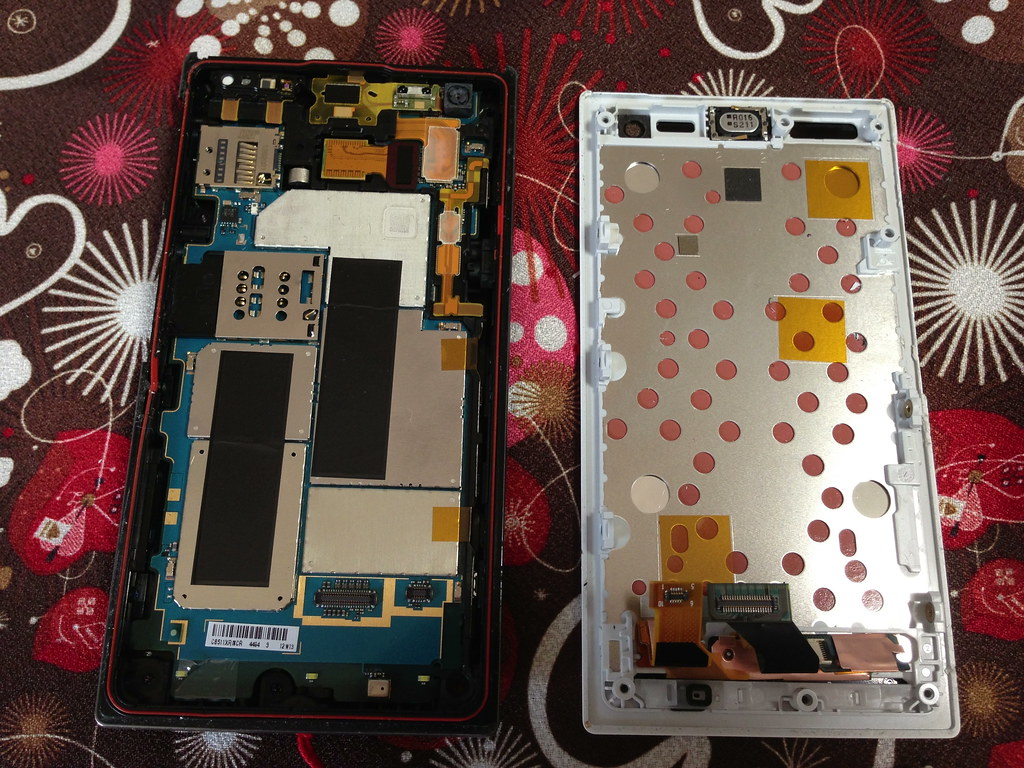
The battery in the phone has swollen and has to be replaced. The procedure is written out in any teardown guide: the back cover is warmed on a heat mat until the adhesive frame softens, prised up with suction cups, and under the battery itself another strip of glue is released with isopropanol. The labour costs more than the part. The device itself works. It was designed this way.
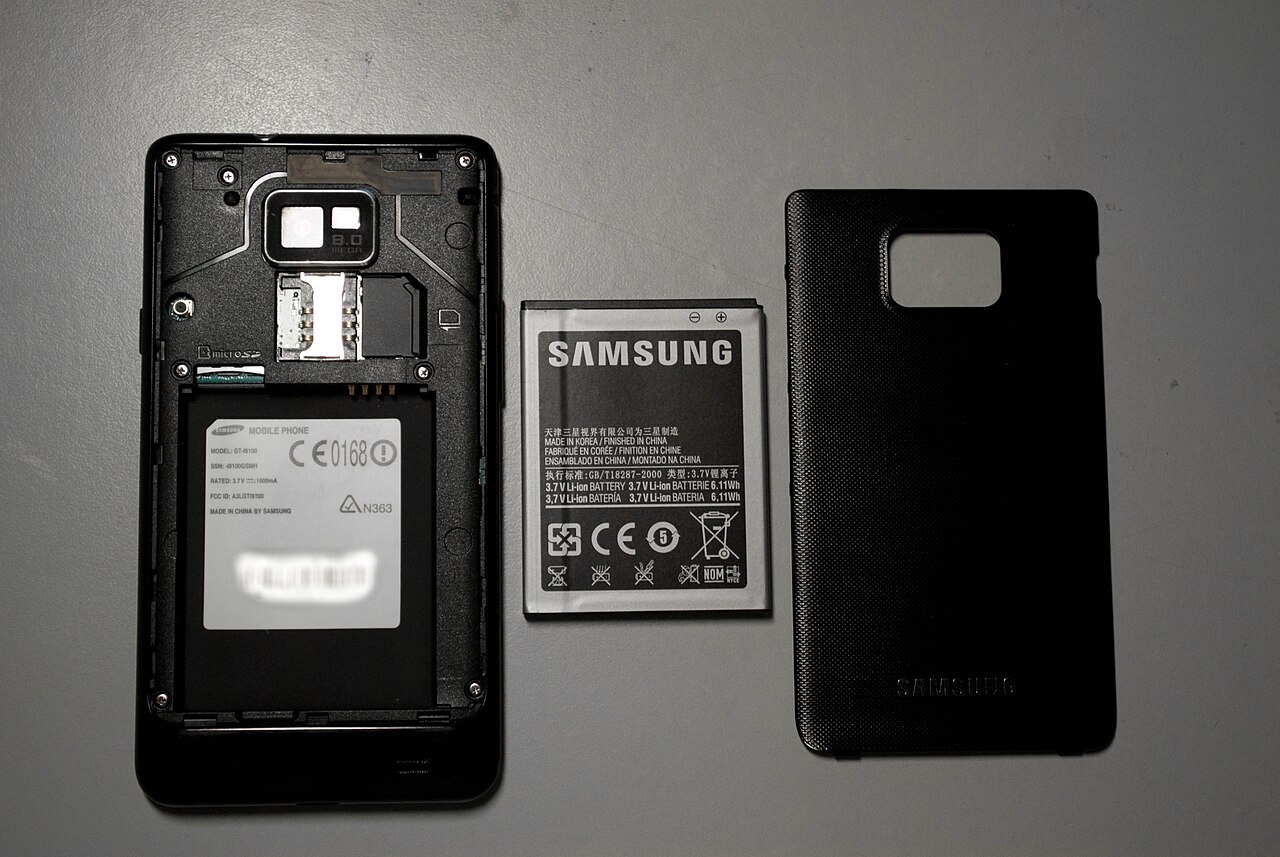
The EU requirement for removable batteries gets read as a promise to bring back the cover you flick off with a fingernail — the one phones had until the middle of the 2010s. Hence the scepticism: a thin body cannot be built with a cover like that, so the rule will be either repealed or worked around. The other widespread assumption is that no such requirement existed before. It has existed since 2006.
The old requirement was about waste
Directive 2006/66/EC put the obligation on member states, in Article 11:
Member States shall ensure that manufacturers design appliances in such a way that waste batteries and accumulators can be readily removed
One sentence, and three weak points inside it.
The addressee is member states rather than whoever puts the product on the market: the duty reaches the manufacturer through national law, and disperses along the way. The object is waste batteries, a battery that has already become waste; taking it out falls to a recycler at the end of life, not to the owner in the middle of it. And the crucial one: readily is never unpacked anywhere in the directive. Whether a battery you extract with a heat gun over forty minutes counts as readily removable is a question the text leaves unanswered.
Regulation (EU) 2023/1542 rewrites the same rule and closes each of the three holes separately. It speaks to "any natural or legal person that places on the market products incorporating portable batteries", and it demands that those batteries be "readily removable and replaceable by the end-user at any time during the lifetime of the product". The right-hand column is the one to read:
| What the rule sets | Directive 2006/66/EC | Regulation 2023/1542 |
|---|---|---|
| Who it addresses | member states | whoever places the product on the market |
| When the battery comes out | once it has become waste | at any time during the product's lifetime |
| What "readily" means | not defined | a list of forbidden ways of getting in |
The bottom row is the one that matters. While the word "readily" stays undefined, the requirement cannot be tested against a particular device, and it is out of that definition that everything else in the rule grew.
The rule is written as a list of forbidden methods
For "readily removable" to be testable on a given product, the notion had to be reduced to operations that are either performed or not. The regulation does that not through a property of the battery, and not through a disassembly time, but through a list of what a manufacturer may not oblige you to use:
A portable battery shall be considered readily removable by the end-user where it can be removed from a product with the use of commercially available tools, without requiring the use of specialised tools, unless provided free of charge with the product, proprietary tools, thermal energy, or solvents to disassemble the product
What counts as a commercially available tool is explained in the recitals, in point 38: "tools available on the market to all end-users without the need for them to provide evidence of any proprietary rights and that can be used with no restriction, except health and safety-related restrictions". A tool sold to anybody who wants one.
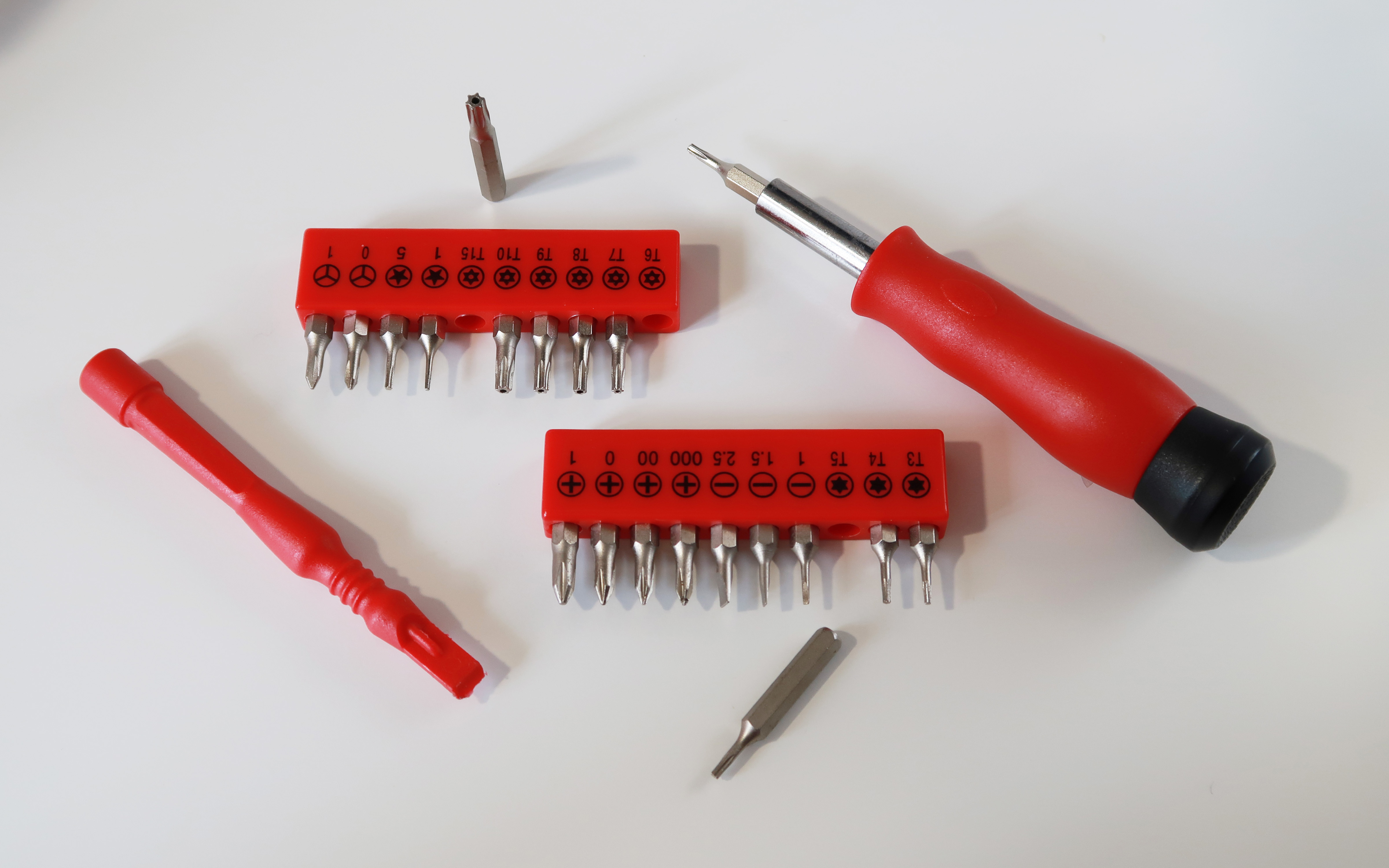
Every line of that list is a design decision crossed out. The heat mat is thermal energy. The isopropanol under the adhesive frame is a solvent. A screw with a head of its own, whose driver you can buy only from an authorised service centre, is a proprietary tool. Not one of the items describes the battery: what the regulation governs is glue and fasteners.
That exception for a free special key turns the usual picture of the rule inside out. The requirement is not about doing it without tools, and not about a cover that unclips under a fingernail. It is about the tool being obtainable rather than absent, and a device with an awkward screw stays lawful for exactly as long as the driver for it lies in the same box.
One line vanished from the list of exceptions
The old directive allowed a battery to stay fixed in place "where, for safety, performance, medical or data integrity reasons, continuity of power supply is necessary and requires a permanent connection". Four grounds. The new Article 11(3) leaves two, and the second one comes fenced: "to ensure the safety of the user and the appliance or, for products that collect and supply data as their main function, for data integrity reasons".
Gone is the word performance. Gone with it is the ground that almost anything fitted: a thinner body, a stiffer frame, better heat removal, all of it a matter of how the product performs, and every one of those arguments was formally accepted by the old directive.
Medical equipment was taken out of the exceptions as well — not released from the rule, but moved into a different category. For professional radiotherapy and imaging apparatus, and for in vitro diagnostic devices, Article 11(2) allows the battery to be replaceable "only by independent professionals". Not irreplaceable. The same regime went to appliances that work under splashing water, water jets or immersion and that are washed or rinsed, and even for those, recital 39 attaches a condition: the relaxation holds only where safety cannot be achieved "by way of redesign of the appliance". Redesign first; the relaxation only if that fails.
Another line shuts the route through firmware:
Software shall not be used to impede the replacement of a portable battery or LMT battery, or of their key components, with another compatible battery or key components
Pairing a battery to the mainboard as a way of blocking a compatible replacement falls inside that directly.
Two dates with nothing empty between them
The regulation applies from 18 February 2024, which is what Article 96(2) says. For Article 11 the same paragraph makes a separate reservation: that one applies from 18 February 2027. The difference is exactly three years, and Article 95 makes sure those three years hold no vacuum — the old Article 11 of Directive 2006/66/EC stays in force "until 18 February 2027", to the day.
Why three years, the regulation does not explain. Delays of that length are not handed out for labelling or documentation requirements, though; they are handed out when a rule reaches into what gets decided while the enclosure is still being drawn.
Beside it stands a period running after the sale. Batteries have to remain available as a spare part "for a minimum of five years after placing the last unit of the equipment model on the market", at a "reasonable and non-discriminatory price", to repairers and end-users alike. A model whose last unit shipped in August 2026 drags behind it an obligation to sell a battery for it until August 2031.
What you can look at right now
First check whether Article 11 concerns your thing at all. Portable, for the regulation, means a sealed battery of 5 kg or less that is not specifically designed for industrial use and is not a traction battery. The pack from an electric scooter, or a home power station that weighs more, does not come under this article — other articles cover those.
Then the manufacturer's website. Instructions for removing and replacing the battery have to be "made available permanently online, on a publicly available website"; Article 11(1) requires it. Find that page for your device and read the steps through. If there is a warming stage in them, or a solvent gets mentioned, you are looking at a design that will not be placed on the European market in that form after February 2027. And if a small key of an odd shape came in the box, that is not a shortcoming — that is precisely the option the regulation permits.
What the rule does not promise
Article 11 does not demand that a battery come out by hand: it demands that the tool be purchasable or present in the box. Prices it does not name either — the phrase "reasonable and non-discriminatory price" contains no figure, and an argument over whether a part is priced reasonably is not settled by the regulation's text. All of this holds where goods are placed on the EU market.
The sources this article was written from
- Regulation (EU) 2023/1542, Article 11(1) — removability and replaceability of portable batteries; on the addressee, verbatim: «any natural or legal person that places on the market products incorporating portable batteries»; on the moment: «readily removable and replaceable by the end-user at any time during the lifetime of the product»; the definition: «A portable battery shall be considered readily removable by the end-user where it can be removed from a product with the use of commercially available tools, without requiring the use of specialised tools, unless provided free of charge with the product, proprietary tools, thermal energy, or solvents to disassemble the product»; the instructions — «made available permanently online, on a publicly available website»; the ban on blocking replacement in software — «Software shall not be used to impede the replacement of a portable battery or LMT battery, or of their key components, with another compatible battery or key components»
Regulation (EU) 2023/1542 — https://eur-lex.europa.eu/legal-content/EN/TXT/PDF/?uri=CELEX:32023R1542 - Regulation (EU) 2023/1542, recital 38 — the definition of a commercially available tool, verbatim: «tools available on the market to all end-users without the need for them to provide evidence of any proprietary rights and that can be used with no restriction, except health and safety-related restrictions»
Regulation (EU) 2023/1542 — https://eur-lex.europa.eu/legal-content/EN/TXT/PDF/?uri=CELEX:32023R1542 - Regulation (EU) 2023/1542, Article 11(3) — the two grounds for keeping a battery non-removable, verbatim: «to ensure the safety of the user and the appliance or, for products that collect and supply data as their main function, for data integrity reasons»
Regulation (EU) 2023/1542 — https://eur-lex.europa.eu/legal-content/EN/TXT/PDF/?uri=CELEX:32023R1542 - Regulation (EU) 2023/1542, Article 11(2) and recital 39 — the regime for medical devices and washable appliances: replacement «only by independent professionals», the relaxation applying only where safety cannot be achieved «by way of redesign of the appliance»
Regulation (EU) 2023/1542 — https://eur-lex.europa.eu/legal-content/EN/TXT/PDF/?uri=CELEX:32023R1542 - Regulation (EU) 2023/1542, Article 11(7) — the spare part «for a minimum of five years after placing the last unit of the equipment model on the market» at a «reasonable and non-discriminatory price»
Regulation (EU) 2023/1542 — https://eur-lex.europa.eu/legal-content/EN/TXT/PDF/?uri=CELEX:32023R1542 - Regulation (EU) 2023/1542, Article 96(2) and Article 95 — dates of application; the old Article 11 of the directive applies «until 18 February 2027». Definition of a portable battery — weight «5 kg or less»
Regulation (EU) 2023/1542 — https://eur-lex.europa.eu/legal-content/EN/TXT/PDF/?uri=CELEX:32023R1542 - Directive 2006/66/EC, Article 11 — the previous wording of the requirement, verbatim: «Member States shall ensure that manufacturers design appliances in such a way that waste batteries and accumulators can be readily removed», and the old list of exceptions «where, for safety, performance, medical or data integrity reasons, continuity of power supply is necessary and requires a permanent connection»
Directive 2006/66/EC — https://eur-lex.europa.eu/legal-content/EN/TXT/HTML/?uri=CELEX:32006L0066